How to Source CNC Machined Parts From China Without Surprises
Most quality problems with imported machined parts come from requirements that were never written down. This guide walks through the RFQ package, first article approval, inspection documents, Incoterms and shipping.
By the Axisform engineering teamPublished Updated 7 min read
To source CNC machined parts from China without quality surprises, send a complete RFQ package (3D model, toleranced 2D drawing, material, finish, quantities and inspection requirements), approve a first article with a dimensional report before production, require inspection reports and material certificates with each shipment, and agree on Incoterms and packaging in writing. Most quality problems come from information that was never written down, not from machine capability. The steps below make expectations explicit at each stage.
Why do quality surprises happen with overseas suppliers?
Quality issues on imported machined parts usually trace back to a small number of causes:
Ambiguous drawings. Missing tolerances, unclear finish specs or no note on whether dimensions apply before or after coating.
Assumptions about material. "Aluminum" or "stainless" without a grade and temper.
No agreed inspection method. The buyer measures with a CMM; the supplier measured with calipers.
Cosmetic expectations not defined. Scratches, tool marks and color shifts that one side considers acceptable and the other does not.
Changes after approval. A revision that never reached the shop floor, or a process change that was not communicated.
Each of these is preventable with documentation and a clear approval process.
What should a complete RFQ package include?
A complete request for quotation gets you an accurate quote faster and prevents errors later.
3D CAD model in a neutral format such as STEP (preferred), IGES or Parasolid (X_T).
2D drawing (PDF) with tolerances, datums, GD&T, surface roughness, thread specifications and a general tolerance note such as ISO 2768-mK. The drawing, not the model, should be the controlling document for tolerances.
Revision level on every file, matching between model and drawing.
Material with grade and temper (for example "6061-T6," "304 stainless," "C36000 brass") and any required standard.
Finish specification with type, color, thickness and masking (for example "Anodize Type II Class 2, black, 10–15 µm, mask threads").
Quantities, ideally several tiers (for example prototype, pilot and production), so you understand how price scales.
Critical-to-function dimensions flagged on the drawing.
Inspection and documentation requirements: first article report, CMM report, material certificates, certificate of conformance.
Cosmetic standard: which surfaces are cosmetic, what defects are acceptable and at what viewing distance.
Packaging and labeling requirements.
Target delivery date and preferred Incoterm.
If your design is confidential, send a non-disclosure agreement before or with the RFQ.
What questions should the supplier ask back?
A good supplier will return engineering questions (sometimes called an EQ or DFM review) before quoting or before production: conflicting dimensions, unachievable tolerances, finish allowances, thread callouts and material availability. Treat these questions as a sign of diligence. A supplier that quotes a complex drawing with no questions at all may not have read it closely.
What is a first article inspection (FAI) and why does it matter?
A first article inspection is a full dimensional and documentation check of the first part(s) produced with the production process. It verifies that the process can make the part to the drawing before the full batch is run.
A useful FAI package contains:
A ballooned drawing — every dimension and note numbered.
A measurement report listing each balloon, the nominal, the tolerance, the measured value and pass/fail.
Material certificate for the raw material lot.
Finish verification — coating thickness, color comparison, salt spray or other test results if required.
Photos of cosmetic surfaces.
Aerospace suppliers often use the AS9102 format, and automotive programs may require PPAP. For most industrial parts, a ballooned drawing with a complete measurement report is sufficient.
Should you order samples before production?
For new parts, new suppliers or critical assemblies, yes. Order a small quantity of samples, test them in your assembly, and approve them in writing. Keep at least one approved sample as a "golden sample" for future reference, especially for cosmetic finishes and color.
What inspection reports should you require?
Match the documentation to the risk of the part:
Document
What it shows
When to require it
Dimensional inspection report
Measured values of critical or all dimensions
Every production shipment
CMM report
Coordinate measurement of complex features and GD&T
Tight positional tolerances, complex geometry
First article inspection (FAI)
Full report on first parts from a new or changed process
New parts, revisions, new suppliers
Material certificate (mill cert)
Chemical composition and mechanical properties of the raw material lot
Structural, safety-critical or regulated parts
Certificate of conformance (CoC)
Supplier statement that parts meet the drawing and PO
Most shipments
Finish/coating report
Coating thickness, adhesion or salt spray results
Functional coatings, outdoor parts
Material certificates are often issued to EN 10204 type 3.1, which certifies test results for the specific lot.
How do you sample a production lot?
For production lots, critical dimensions should be checked at 100% where practical, and other dimensions sampled. ISO 2859-1 (equivalent to ANSI/ASQ Z1.4) defines AQL sampling plans that let you inspect a statistically based sample size for a given lot size. State the AQL level in your purchase order or quality agreement if you need it. For high-risk parts, a third-party pre-shipment inspection is another option.
Which Incoterms should you use?
Incoterms 2020 define who pays for transport, insurance and duties and where risk transfers from seller to buyer. The most common options for machined parts:
Incoterm
Seller's responsibility
Buyer's responsibility
Notes
EXW (Ex Works)
Makes goods available at the factory
Everything from pickup, including export clearance
Most work for the buyer
FCA (Free Carrier)
Delivers to buyer's carrier, export-cleared
Main transport, import
Suits air freight and express
FOB (Free On Board)
Delivers onto the vessel at the port, export-cleared
Ocean freight, insurance, import
Sea freight only
CIF (Cost, Insurance and Freight)
Pays freight and minimum insurance to destination port
Import clearance, duties, delivery
Sea freight only; risk passes at loading
DAP (Delivered at Place)
Delivers to named destination
Import clearance and duties
Common for express
DDP (Delivered Duty Paid)
Delivers to destination including duties and import clearance
Unloading
Least work for the buyer
FOB and CIF are designed for sea and inland waterway transport. For air freight and express courier shipments, FCA, CPT, CIP, DAP or DDP are more appropriate, although FOB is still used informally.
How should machined parts be shipped from China?
Express courier (DHL, FedEx, UPS) is the usual choice for prototypes, samples and small production lots. It is fast and door-to-door.
Air freight suits larger, urgent production shipments.
Sea freight is the most economical for heavy or high-volume shipments, with longer transit times.
What about customs and duties?
The importer is responsible for classifying parts with the correct HS (Harmonized System) code and paying applicable duties. Tariff rates depend on the product classification, the destination country and current trade measures, and they change. Check current rates with your customs broker before committing to a landed cost. Provide the supplier with any specific invoice or labeling requirements in advance.
How should parts be packed?
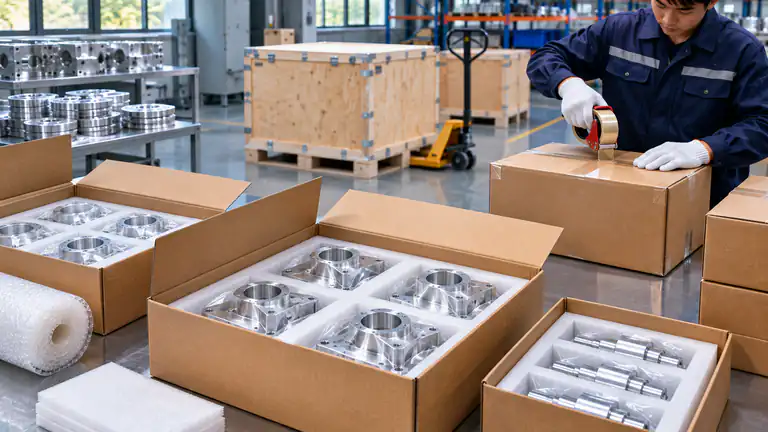
Anodized and cosmetic parts: individual bags or foam separation to prevent rubbing.
Steel parts: anti-rust oil or VCI (volatile corrosion inhibitor) packaging.
Precision features: protective caps on threads and bores.
Labels with part number, revision, quantity and lot number on each inner pack.
Strong outer cartons, palletized for freight.
How do you manage communication and revisions?
Name one engineering contact on each side. This prevents conflicting instructions.
Control revisions. Every drawing change gets a new revision letter, and the purchase order references the revision.
Write down approvals. Email confirmation of sample approval, deviations and changes.
Agree on non-conformance handling — how rejected parts are reported, with photos and measurements, and how rework or replacement is handled.
Allow for time zones. A clear question sent at the end of your day can be answered by the start of your next working day.
How does Axisform handle this process?
Axisform works under an ISO 9001 quality management system from its production base in Dongguan, Guangdong. Quotes are usually returned within 24 hours on business days. Each order typically includes first-article inspection, in-process checks and 100% inspection of critical dimensions before shipment; inspection reports and material certificates are available on request. Shipping is by DHL, FedEx, UPS, air or sea freight, with EXW, FOB, CIF or DDP terms by agreement. See about us, our projects, or send your RFQ package through contact.
Before sending the RFQ, it is worth checking your design against our DFM rules and tolerance guide.
Frequently asked questions
What files should I send to get a CNC machining quote?
Send a 3D model in STEP format and a 2D PDF drawing with tolerances, material, finish and quantities. The 3D model defines geometry, while the drawing defines tolerances, threads, surface finish and inspection requirements.
What is the difference between FAI and pre-shipment inspection?
A first article inspection checks the first parts from a new process against every drawing requirement before production. A pre-shipment inspection checks a finished production lot, usually by sampling, before it leaves the factory.
Which Incoterm is best when buying from China?
It depends on how much logistics you want to manage. EXW and FOB give the buyer more control over freight; DDP gives the simplest delivery with duties included. For express and air shipments, FCA, DAP or DDP fit better than FOB or CIF.
How can I verify the material used in my parts?
Request a material certificate (mill certificate) for the raw material lot, often to EN 10204 3.1. For critical parts, you can also have a sample tested independently, for example by spectrometer analysis.
Written by the Axisform engineering team
Manufacturing and quality engineers at our Dongguan machining factory. Questions about this guide? Email us.
Need parts made to these principles?
Send your drawing and an engineer will reply with DFM notes and a quote within 24 hours.
A good metal knob depends as much on its bore fit and runout as on its finish. This guide covers knurling patterns, materials, finishes and the main ways knobs attach to shafts in audio, appliance and automotive controls.
Sheet metal is usually cheaper for uniform-wall enclosures and brackets, while CNC machining wins on varying thickness and tight tolerances. This guide compares both and explains bend radius and K-factor basics.
Most of the cost of a machined part comes from machine time, setups and inspection rather than material. These 12 design rules target each of them without changing how the part works.