Sheet Metal Fabrication vs CNC Machining for Enclosures
Sheet metal is usually cheaper for uniform-wall enclosures and brackets, while CNC machining wins on varying thickness and tight tolerances. This guide compares both and explains bend radius and K-factor basics.
By the Axisform engineering teamPublished 7 min read
Choose sheet metal fabrication for enclosures, covers and brackets with a uniform wall thickness, bent flanges and moderate tolerances; it uses less material, needs less machine time per part and becomes much cheaper than machining as quantity grows. Choose CNC machining when the part has varying wall thickness, pockets, bosses, tight tolerances across several faces, or when you need a small number of parts with complex 3D geometry. Many good enclosure designs combine both: a bent sheet metal body with machined or inserted features where precision is needed.
How are sheet metal and CNC machined parts made?
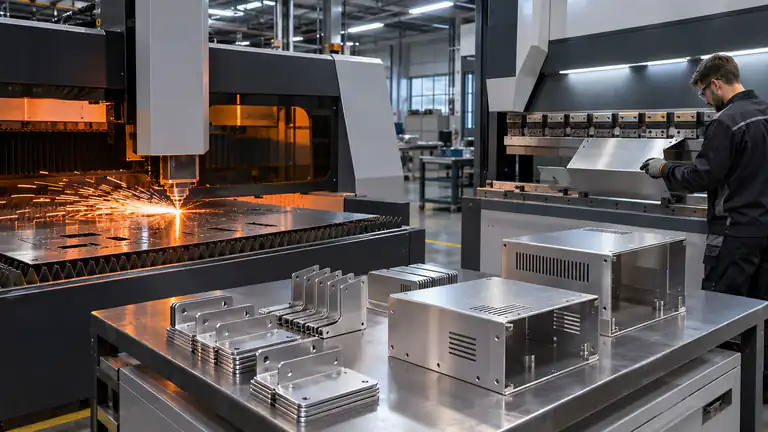
Sheet metal fabrication starts with flat sheet, typically 0.5–6 mm thick. The flat pattern is cut by laser or punching, then formed on a press brake into flanges and boxes. Features are added with hardware insertion (self-clinching nuts, studs and standoffs), welding, tapping or countersinking. Higher volumes may use stamping dies.
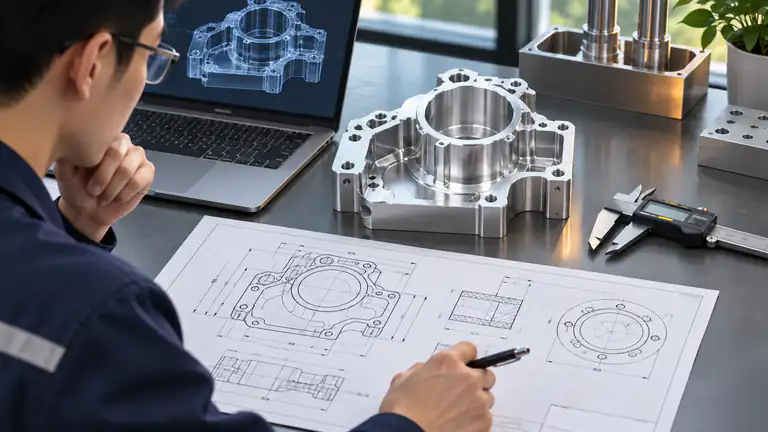
CNC machining starts with a solid block, bar or plate and removes material with milling and turning tools until only the part remains. Wall thickness, pockets, bosses and threads can vary freely across the part.
The difference in starting material drives everything else: material use, cost structure, tolerance and design freedom.
Sheet metal vs CNC machining: comparison table
Factor
Sheet metal fabrication
CNC machining
Starting material
Flat sheet (typically 0.5–6 mm)
Solid block, plate or bar
Wall thickness
Uniform, equal to sheet thickness
Can vary across the part
Geometry
Flat panels, bends, flanges, cut-outs
Pockets, bosses, 3D surfaces, threads anywhere
Typical tolerances
Laser-cut features around ±0.1 mm; bent dimensions looser, often ±0.2–0.5 mm; bend angle around ±0.5–1°
±0.05 mm standard; down to ±0.01 mm or tighter on critical features
Large enclosures and chassis. A 300 × 200 × 100 mm box machined from solid wastes most of the block; folded from 1.5 mm sheet, it uses a fraction of the material.
Brackets with simple L, U or Z shapes. Laser-cut and bent in minutes.
Uniform wall thickness. If every wall is the same thickness and loads are moderate, sheet metal is usually the efficient choice.
Medium to high quantities. Per-part cost falls quickly, and stamping dies reduce it further at higher volumes.
Weight-sensitive covers and panels.
When does CNC machining make more sense?
Parts with varying thickness: thick mounting bosses, thin pockets and heat sink fins.
Tight tolerances on several faces, such as bearing bores or sealing faces relative to mounting holes.
Cosmetic or sealed housings without visible bends, seams or welds, for example milled aluminum electronics enclosures with an O-ring groove.
Very low quantities of complex parts, where a sheet metal design would require welding several pieces together.
Thick, stiff brackets where sheet metal would need many bends or reinforcements.
What are the key sheet metal design rules?
Sheet metal has its own DFM rules. Getting them right avoids cracked bends, distorted holes and rework.
What is the minimum bend radius?
The inside bend radius should usually be at least equal to the material thickness (1T) for ductile materials such as mild steel and 5052 aluminum. Harder or less ductile materials need more. Heat-treated aluminum such as 6061-T6 tends to crack on tight bends and typically needs a radius of several times its thickness, which is why 5052 is the standard aluminum for bent parts. Using standard punch radii that your supplier already has also reduces cost.
What is the K-factor?
When sheet bends, the material on the inside of the bend compresses and the outside stretches. Somewhere in between is the neutral axis, which keeps its original length. The K-factor is the position of the neutral axis expressed as a fraction of the thickness, measured from the inside surface:
K = t / T, where t is the distance from the inside surface to the neutral axis and T is the sheet thickness.
Typical values range from about 0.3 to 0.5. Tight bends (small radius relative to thickness) are usually toward the lower end; generous bends move toward 0.5.
CAD software uses the K-factor to calculate the flat pattern. The bend allowance (the arc length of the neutral axis through the bend) is:
BA = π × (R + K × T) × (A / 180)
where R is the inside bend radius, T the thickness and A the bend angle in degrees.
Example: 2 mm aluminum, inside radius 2 mm, K = 0.4, 90° bend: BA = π × (2 + 0.8) × 0.5 ≈ 4.40 mm.
In practice, the supplier adjusts the flat pattern to its own press brake tooling and material. Send a 3D model with the bend radius and thickness defined, and let the fabricator finalize the flat pattern unless you have a validated K-factor from the same supplier.
What other sheet metal rules matter?
Minimum flange length: usually around 4 times the material thickness, depending on the V-die width. Shorter flanges cannot be formed reliably.
Hole-to-bend distance: keep holes at least about 2.5 times the thickness plus the bend radius from the bend line, or they will distort.
Bend relief: add a small relief cut where a bend meets an edge, to prevent tearing.
Hole size: holes in sheet metal should generally be at least as large as the material thickness.
Hardware: use self-clinching nuts, studs and standoffs instead of tapping thin sheet; thread engagement in 1 mm sheet is too short to be reliable.
Tolerances: do not apply machining tolerances to bent dimensions. Dimension critical features from a single datum, ideally within the same flat face.
Where is the cost crossover between sheet metal and CNC machining?
There is no single crossover quantity, because it depends on size, material and complexity. The general pattern:
Small, compact, complex parts: machining is often competitive even at higher volumes, since material waste is small and sheet metal may need several operations.
Large, thin-walled enclosures: sheet metal is usually cheaper even at one piece, because machining a large block takes long cycle times and wastes material.
Simple brackets: sheet metal is typically cheaper from very low quantities upward.
High-volume flat or formed parts: stamping becomes the cheapest per part once tooling cost is spread over enough quantity.
The practical approach is to quote both options for borderline parts. A supplier that offers both processes can compare them on the same drawing.
Can you combine sheet metal and machined parts?
Yes, and it is often the best answer:
A sheet metal enclosure with a machined front panel or a machined heat sink bolted on.
A bent bracket with a machined boss welded or pressed in.
Sheet metal parts with countersinks, tapped holes or flattened faces machined after forming for precision.
Laser-cut flat parts without bending, finished with machined features — a good option for thick plates that do not need 3D pockets.
What finishes work for each process?
Both processes accept the same main finishes: powder coating, painting, anodizing (for aluminum), electroplating, passivation and brushing. Note that:
Powder coating is the most common finish for steel enclosures, and it adds noticeably more thickness than anodizing.
5052 aluminum anodizes well but with a slightly different tone than 6061; if a sheet metal cover sits next to a machined 6061 part, check color consistency. See our anodizing guide.
Welded seams on sheet metal may show through thin finishes and need grinding.
How Axisform can help
Axisform offers laser cutting, sheet-metal bending, stamping and welding alongside 3-, 4- and 5-axis CNC machining, so both routes can be quoted from the same drawing. Browse products or send your design through contact. For machining-specific design rules, see our DFM guide.
Frequently asked questions
Is sheet metal cheaper than CNC machining?
For enclosures, brackets and panels with uniform wall thickness, sheet metal is usually cheaper, especially as quantity increases. For small, complex parts or parts with tight tolerances and varying thickness, CNC machining can be more economical.
What is a typical K-factor for sheet metal?
K-factor values typically range from about 0.3 to 0.5, depending on material, thickness, bend radius and tooling. Tight bends tend toward the lower end; for accurate flat patterns, use the K-factor validated by your fabricator.
Can 6061 aluminum be bent?
6061-T6 can be bent, but it tends to crack on tight radii and needs a generous bend radius. 5052 aluminum is the usual choice for bent sheet metal parts because it forms well with a radius close to its thickness.
What tolerances can sheet metal hold?
Laser-cut features typically hold around ±0.1 mm, while dimensions across bends are looser, commonly ±0.2–0.5 mm, and bend angles around ±0.5–1°. For tighter tolerances, machine critical features after forming or use a CNC machined part.
Written by the Axisform engineering team
Manufacturing and quality engineers at our Dongguan machining factory. Questions about this guide? Email us.
Need parts made to these principles?
Send your drawing and an engineer will reply with DFM notes and a quote within 24 hours.
A good metal knob depends as much on its bore fit and runout as on its finish. This guide covers knurling patterns, materials, finishes and the main ways knobs attach to shafts in audio, appliance and automotive controls.
Most quality problems with imported machined parts come from requirements that were never written down. This guide walks through the RFQ package, first article approval, inspection documents, Incoterms and shipping.
Most of the cost of a machined part comes from machine time, setups and inspection rather than material. These 12 design rules target each of them without changing how the part works.